
Robotics: The Year of RL in Robotics
2025 is the year of agents in the LLM world—and the year of RL in robotics.
Robots today are roughly where $TSLA’s Autopilot was in 2019–2020.
Optimus walking or dancing? Probably comparable to Tesla’s early lane-following.
Reinforcement Learning (RL) is one of the few learning algorithms that can operate across both:
🧠 The world of bits
🤖 And the world of atoms
But there’s still a lot of jargon and confusion in this space. Here’s one way to frame the core approaches—using a simple 2×2 matrix:
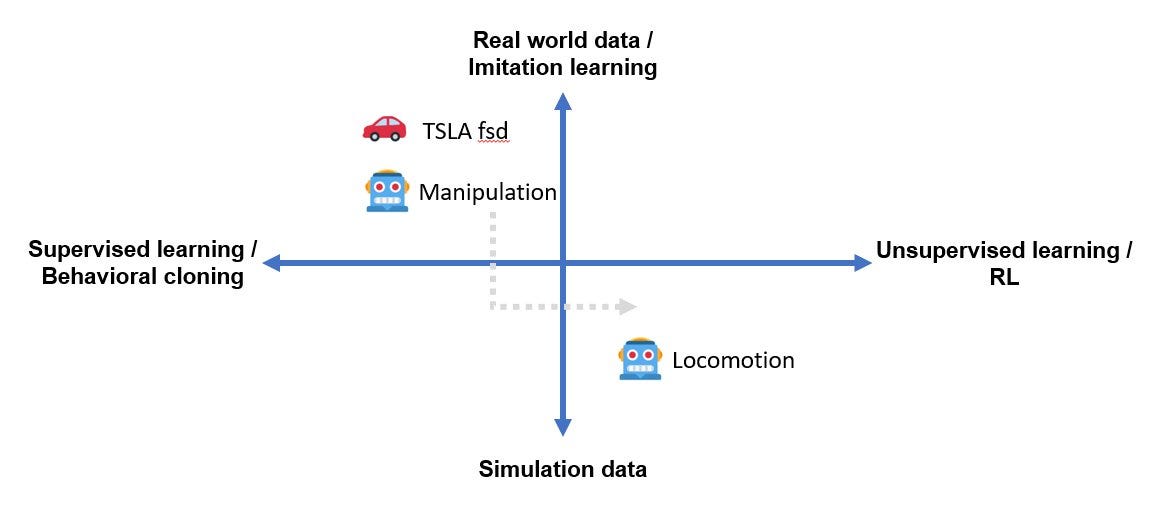
🧭 A Simple Framework for Robotics Learning
Use CaseData TypeLearning TypeExample / CommentFSDReal-worldSupervised (+RL)$TSLA Autopilot, lane followingLocomotionSimulationRLUnitree, Optimus – trained in sim, deployed in real worldManipulationEvolvingHybridVaries – mix of supervised + RL, often using real data
✅ Locomotion = Sim Data × RL
Locomotion is largely solved with RL.
Robots are trained entirely in simulation
Then transferred directly to the real world
The sim-to-real gap is no longer a major blocker
RL has improved too—it’s no longer limited to one-off tasks.
Today’s RL can generalize across a broader set of useful behaviors.
🔍 Open question: How general can this get?
So far, even similar actions (e.g., hiking, running, dancing) still require separate models.
🧩 Manipulation = Still Evolving
Manipulation is a much harder problem.
In theory, we want it to be sim data × RL too—but:
The reward functions are harder to define
Walking = “don’t fall”
Opening a door = ???
Real-world tasks are highly variable
Most models today rely on real-world data × supervised learning
With the rise of VLA (Vision-Language-Action) models, we’re starting to see hybrid approaches:
sim + real data × supervised learning
→ and slowly, RL is entering the mix
🔍 First Principles: The Real Bottleneck Is Data
Zooming out, the real bottleneck becomes clear:
Data.
Imitation learning doesn’t scale.
Most teams are still paying $50–$100/hour for manual data collection.
Want 100 million hours of interaction?
You’re looking at billions of dollars, before even testing your scaling law.
This leaves two paths forward:
Path 1: Breakthroughs in simulation
$NVDA’s role becomes critical
Need to "sim everything"
Must model real-world physics, materials, edge cases
Path 2: Real-world agents, born digital
Start with agents that master software, screens, and interfaces
From 2D → 3D: expand from the digital world into the physical
Let AI adapt to hardware, not the other way around
📈 Why Robotics Really Matters
Productivity growth is the only thing that moves GDP long term.
And robotics may be the biggest unlock in decades.
McKinsey estimates that AI + robotics could raise U.S. productivity from ~1.8% → 3–4% annually.
That’s trillions in added GDP
Enough to offset demographic drag from aging populations
🏭 A National Strategy
But this isn’t just about economic growth.
In a fractured, post-globalization world, robotics should be a national strategy.
It’s the only way the U.S. and its allies can reshore manufacturing without giving up cost competitiveness.
Robots flatten the global labor curve—on both cost and quality.