

Implications - if successful:
If successful, this could be the “Android” of self-driving.
OEM accessibility improves materially. Many automakers could ship credible self-driving systems without spending billions on model development. For reference, TSLA’s self-driving training spend is estimated at $3–4B in FY24, with ~$5B per year likely required to sustain its edge.
The constraint shifts to time and hardware readiness - most cars on the road today only have 1-2 cameras - but that’s just a matter of time (and Chinese OEMs don’t have that constraint).
Platform economics improve for Uber / Lyft–style networks.
Setup
Why this one might work:
This approach is directionally very similar to Tesla’s, both in hardware philosophy and end-to-end learning.
NVDA is not just selling tools anymore (as they’ve been doing before; with limited success) - it is now offering a complete model.
Questions:
Track record: has been investing in autonomous driving for years, with mixed, publicly visible outcomes. This is the first time it is offering the full “brain” - not just the picks-and-shovels stack. Whether the model performs at production-grade levels, across real-world edge cases, remains an open question until it is road-tested at scale.
OEM adoption
Whether this model can get enough data
NVDA: trained on 80,000 hours of multi-camera driving video (>1B images), with disclosed real-world data spanning 25 countries, 2,500+ cities, and 1,727 hours.
TSLA: reports ~7B cumulative miles driven with FSD engaged. At 30 mph average speed → ~238M hours.
Bottom line:
You can read the paper 100x, but the real answer only comes from on-road performance. In this case, the first meaningful signal will be the Mercedes-Benz CLA deployments, expected in 2026. Until then, most conclusions are educated guesswork, and Tesla will likely continue to trade with a higher, sentiment-driven discount rate.
Self-driving remains frontier tech. There is still no consensus on:
Long-term market penetration, or
Sustainable market share for any single player
As a result, any new information that meaningfully shifts expectations on either dimension is likely to amplify volatility.
Approach -
Before: Mostly “Picks and Shovels”
NVIDIA sold the platform:
In-car compute (DRIVE)
Software stack
Reference architectures
Simulation and training tooling
The driving policy itself - end-to-end model design and trained weights - was owned by OEMs, Tier-1s, or AV developers.
After: Offering the “Brain”
NVIDIA now provides a 10B-parameter VLA (Vision-Language-Action) model.
Training Stack
Training Chips
Trained on NVIDIA H100 (Hopper) clusters
Next-generation versions are being trained on Blackwell (B200)
Training Data
Total volume:
80,000 hours of multi-camera driving video
>1 billion images
Real-world data:
Collected across 25 countries and 2,500+ cities
1,727 hours explicitly referenced in the paper
Includes 360° camera coverage, plus LiDAR and radar for physical grounding
Data collection platform:
Vehicles instrumented to Hyperion 8 / 8.1 (NVIDIA’s AV reference platform)
Open dataset details:
7 cameras + 1 top-mounted 360° LiDAR for all clips
Radar available for a subset (163,850 clips)
Source: Hugging Face dataset
https://huggingface.co/datasets/nvidia/PhysicalAI-Autonomous-Vehicles
Does the model use LiDAR?
Logging includes LiDAR (per open dataset)
https://huggingface.co/datasets/nvidia/PhysicalAI-Autonomous-VehiclesAlpamayo-R1 model inputs (per paper):
Multi-camera video
Calibration
Ego-motion
LiDAR is not explicitly listed as a direct model input
Paper: https://d1qx31qr3h6wln.cloudfront.net/publications/Alpamayo-R1_1.pdf
Versus Tesla
Tesla reports ~7B cumulative miles driven with FSD engaged.
Converting miles to “hours” requires assumptions and is only a rough proxy:
At 30 mph average speed → ~238M hours
Critically:
“Miles driven with FSD engaged” ≠ actual training set
The number is directional, not directly comparable
Customers and Early Partners
Confirmed Production Program
Mercedes-Benz CLA (2026 MY)
Next-generation, EV-first CLA
First U.S. Mercedes running fully on MB.OS
Sensor suite:
10 cameras
5 radar
12 ultrasonic sensors
“Showing Interest” (Important Wording)
Per NVIDIA’s press release - not confirmed production contracts:
Lucid
Jaguar Land Rover (JLR)
Uber
Berkeley DeepDrive
Source (NVIDIA Newsroom):
https://nvidianews.nvidia.com/news/alpamayo-autonomous-vehicle-development?utm_source=chatgpt.com
Hardware
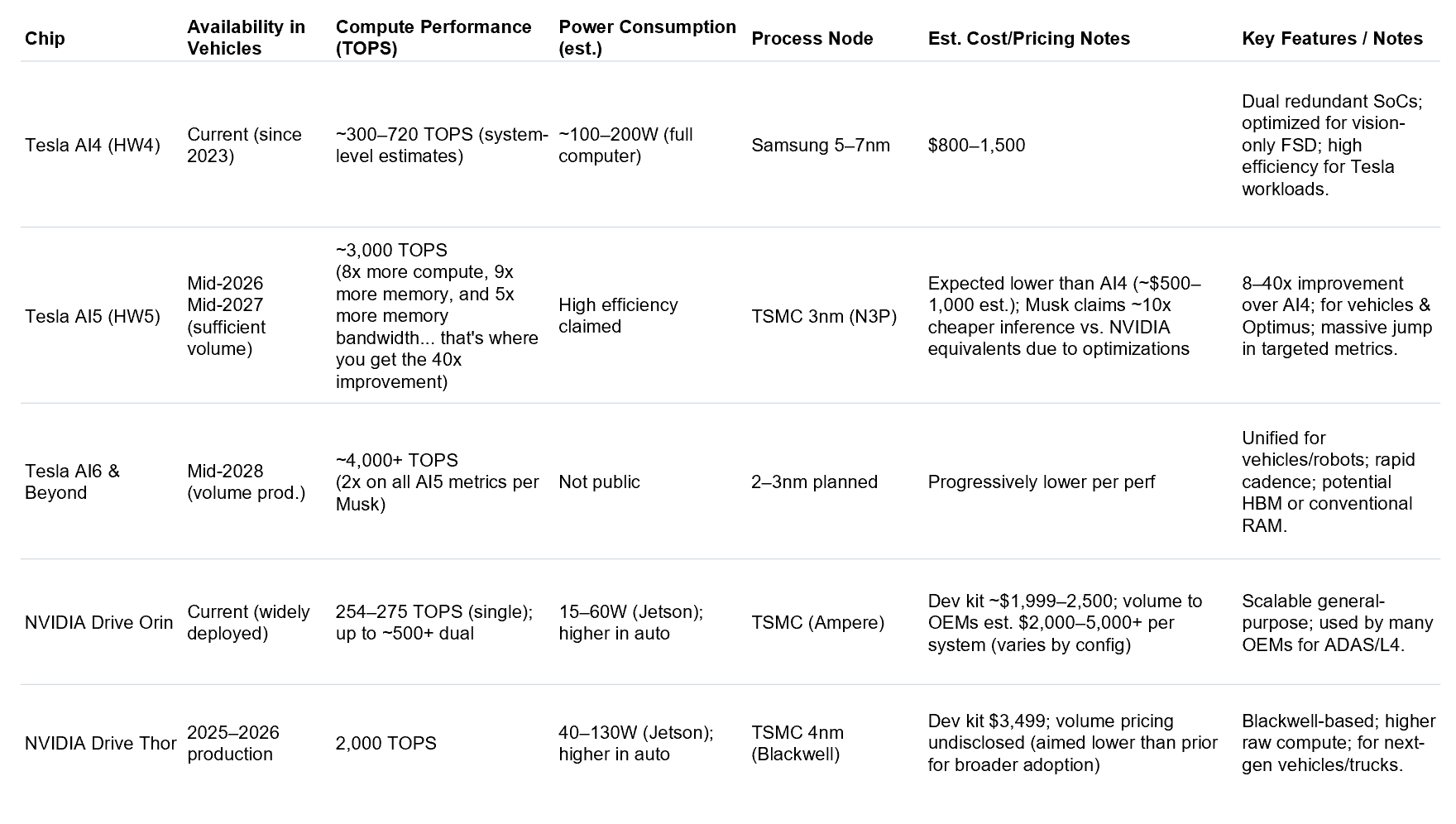
https://arxiv.org/abs/2511.00088
https://research.nvidia.com/publication/2025-10_alpamayo-r1
This is a brilliant strategic breakdown of the "Android vs. iOS" dynamic playing out between Nvidia and Tesla. However, looking under the hood of the Alpamayo architecture, Nvidia’s "Chain-of-Causation" (CoC) reasoning model exposes a deeper structural boundary that scaling laws cannot fix.
The industry is caught in a false dichotomy between Tesla's completely opaque end-to-end "black box" and Nvidia's neuro-symbolic reasoning layers. Both architectures make the exact same foundational epistemic error: they treat an open, underspecified world as a Fully Specified Stochastic Process (FSSP).
An AV’s real-world sensor grid inherently operates within a severely restricted σ-algebra. When the machine encounters a chaotic, long-tail edge case, the incoming data is observationally insufficient to identify the true physical state of the environment.
Tesla handles this by forcing a raw photons-to-control output, blindly gambling through the ambiguity. Nvidia’s Alpamayo attempts to solve this by throwing 32 billion parameters of VLA reasoning at the problem to generate a "Chain-of-Causation" trace. But if the input data layer is too coarse to discriminate between alternative states, that verbalized reasoning isn't a deduction - it is an epistemic supplement forced by the limitations of the reporting box. The system is just rationalizing a forced resolution after the fact.
Without a structural Posterior Safeguard - what I call the Observational Sufficiency Principle (OSP) - hardcoded into the data-generation layer to let the machine explicitly recognize and maintain a safe "known unknown" trajectory buffer, Alpamayo remains vulnerable to the exact same Stand-Still Errors and tracking collapses that plague pure end-to-end networks. It will just generate a highly articulate post-mortem log while it freezes or fails.
I’ve mapped out the formal measure-theoretic breakdown of how forcing an FSSP architecture onto a restricted σ-algebra engineered the infamous 2018 Uber tracking collapse frame-by-frame here, which shows why adding a reasoning layer over an insufficient data layer cannot prevent the structural failure: https://trissimondsen.wordpress.com/2026/04/24/how-osp-would-have-prevented-the-2018-uber-self-driving-crash/
What do you think?
https://forms.gle/Mn7SRBoPXtBG787LA
Hello everyone! I’m a graduate student in the MBA program at National Cheng Kung University in Taiwan. My current research focuses on Driving Automation System, and I would sincerely appreciate it if members of this community could take a few minutes to help me complete this academic research.
Your support will greatly help improve the quality and reliability of this research. Thank you very much for your time and support, and I wish you all a Happy New Year!