
Agentic Commerce | 2026.03

Recap - 3 most interesting developments in agentic commerce over the past few months…
1/ ChatGPT shifting from checkout to discovery
ChatGPT is reportedly scaling back from an end-to-end shopping destination and pivoting to a shopping entry point that routes transactions to specialized commerce apps (source: The Information).2/ Commerce platforms embedding agents directly in their products
Nearly every major commerce platform is now building in-app agentic features (BKNG, EXPE). The most interesting example to me may be AMZN’s “Buy for Me” - an explicitly agentic feature that can complete purchases from other brand websites inside the Amazon Shopping app when Amazon itself does not carry the product.3/ B2B commerce is seeing early agentic adoption on the sourcing side, where the workflow is highly research-intensive.
Guiding principles - what likely holds regardless of how agentic commerce evolves
1/ AI ultimately democratizes information and resources
Commerce has historically been closer to a seller’s market. Consumers are largely shown what platforms choose to surface - through ads, rankings, and distribution channels. Each layer adds another “tax” in the form of marketing spend, platform fees, or payments. AI agents should gradually shift power toward the buyer. Instead of navigating layers of marketing and platform incentives, consumers can theoretically access the best product for their needs directly.
This dynamic may be even more powerful in B2B commerce, which historically has been opaque, fragmented, and relationship-driven.
2/ Faster, cheaper, better still applies
Faster & cheaper: Price competition should intensify across retailers and even payment providers; Scale advantages may matter more, not less - AMZN’s logistics and fulfillment advantage still remains structurally difficult to replicate
Better: more personalized and context-aware - agents matching products to a buyer’s specific needs, constraints, and preferences.
3/ Control of the top of the funnel matters (still)
Today AMZN generates roughly $80B+ (source: Visible Alpha consensus number) in advertising revenue, largely because shopping intent starts on Amazon.
If discovery shifts upstream toward AI interfaces (e.g. ChatGPT or GOOGL’s Gemini), the economics of the top of the funnel could shift meaningfully.
What remains unclear in agentic commerce
Almost everything. Some open questions:
Can agents realistically handle real-world purchase nuances?
size, color, pattern; loyalty programs; travel rewards; hotel room preferences (e.g., window direction)
Will the experience differ materially between web vs. mobile?
What happens to payments and checkout flows if agents can automatically complete forms?
OpenAI
From: ChatGPT as an end-to-end shopping destination. To: ChatGPT as a shopping entry point that hands transactions to connected commerce platforms or merchant sites (e.g., TGT, EXPE, BKNG) or the merchant’s own website.
B2B commerce
VERY research-heavy workflow: The real problem is figuring out what to source, from whom, at what spec, at what price, and with what risk. Buyers often need to compare suppliers across: product specifications; price and MOQ; logistics and lead times; certifications and compliance; production capability. Examples:
A US brand sourcing private-label silicone dog bowls, retailing around $20 with an initial order of 3,000 units.
A French café chain sourcing custom mugs where one supplier is cheaper, another has better lead times, and another has stronger export packaging.
With agents: The buyer simply describes the sourcing need in plain English. AI converts it into a sourcing brief, generates a shortlist of suppliers, and compares price, MOQ, lead time, certifications, and shipping.
BABA’s Accio is an early example of this direction.
By March 2025, Accio had surpassed 1M users within five months
By August 2025, it exceeded 2M users
New features include Business Research, Deep Search, and Accio Agent, pushing toward a more automated sourcing workflow.
AMZN
AMZN has launched several agentic shopping initiatives:
Rufus - AI shopping assistant embedded inside the Amazon store
~250M customers reportedly used Rufus in 2025
users were 60% more likely to complete a purchase
Rufus was projected to drive $10B+ incremental annualized sales
internal models reportedly estimated >$700M of indirect operating profit in 2025
Help Me Decide - personalized product recommendation and narrowing tool
Buy for Me - an agentic feature that can complete purchases from other brand websites inside the Amazon Shopping app when Amazon does not carry the item
Shop Direct - directs users to merchant sites. Shop Direct includes over 100M products from 400k+ merchants
Strategically, this pushes Amazon beyond being just a marketplace into a shopping agent layer. Amazon is positioning itself as the starting point of shopping intent, even when the purchase ultimately happens outside Amazon inventory. Amazon’s framing is explicit: helping customers find and buy a product “even if that product is only available in another store.”
SHOP
Evidence of progress
ChatGPT in-app checkout already works with several SHOP merchants including SKIMS, Glossier, and Spanx (source: https://help.openai.com/en/articles/12440090-instant-checkout-buy-directly-from-merchants-through-chatgpt?utm_source=chatgpt.com)
Shopify reported that orders from AI search increased 15x since January 2025 (from a small base)
Consensus arguments on the Bull case
SHOP may evolve into the infrastructure layer behind AI commerce, not just a storefront tool. Commerce still lacks a universal product catalog, which is extremely difficult to build due to SKU variation. Shopify is opening its agent infrastructure to non-Shopify merchants, expanding its TAM
Agentic commerce could redirect GMV away from closed marketplaces and toward independent merchants, where Shopify is most exposed
Consensus arguments on the Bear case
payment disintermediation
weakening of direct-to-consumer relationships
if agents optimize purely for price and availability, incremental value could shift toward large aggregator platforms rather than independent brands.
Possible outcome
The long-term value of the checkout button becomes less clear. However, Shopify’s take rate (~3%) is already relatively low compared with platforms like OTAs (~13%). That may give SHOP room to evolve additional monetization layers over time.
OTAs (BKNG, EXPE)
One structural advantage OTAs historically had was supply aggregation. BKNG and EXPE built large networks by integrating inventory from thousands of independent hotels, particularly the long tail of properties that lacked the technical capability to integrate with multiple distribution platforms.
AI may reduce that moat: Modern APIs and MCP-style integrations make it easier for hotels to distribute availability, rates, and inventory directly to multiple platforms.
Even with its flaws, GOOGL’s Google Hotels reportedly attracted 350k+ hotels to its “Book Now” program, showing clear interest from suppliers in bypassing OTA commissions.
Consensus arguments on the Bull case
Travel remains structurally complex, as it requires: structured inventory, availability rules, payments, cancellations and changes, customer support
That complexity makes OTAs harder to fully disintermediate compared with simple retail products.
Consensus arguments on the Bear case
AI agents could weaken OTA top-of-funnel advantages. AI makes price comparisons easier, which could pressure take rates and brand loyalty. Over time, if suppliers connect directly to AI agents, some aggregator value could be bypassed - especially in simpler travel segments.
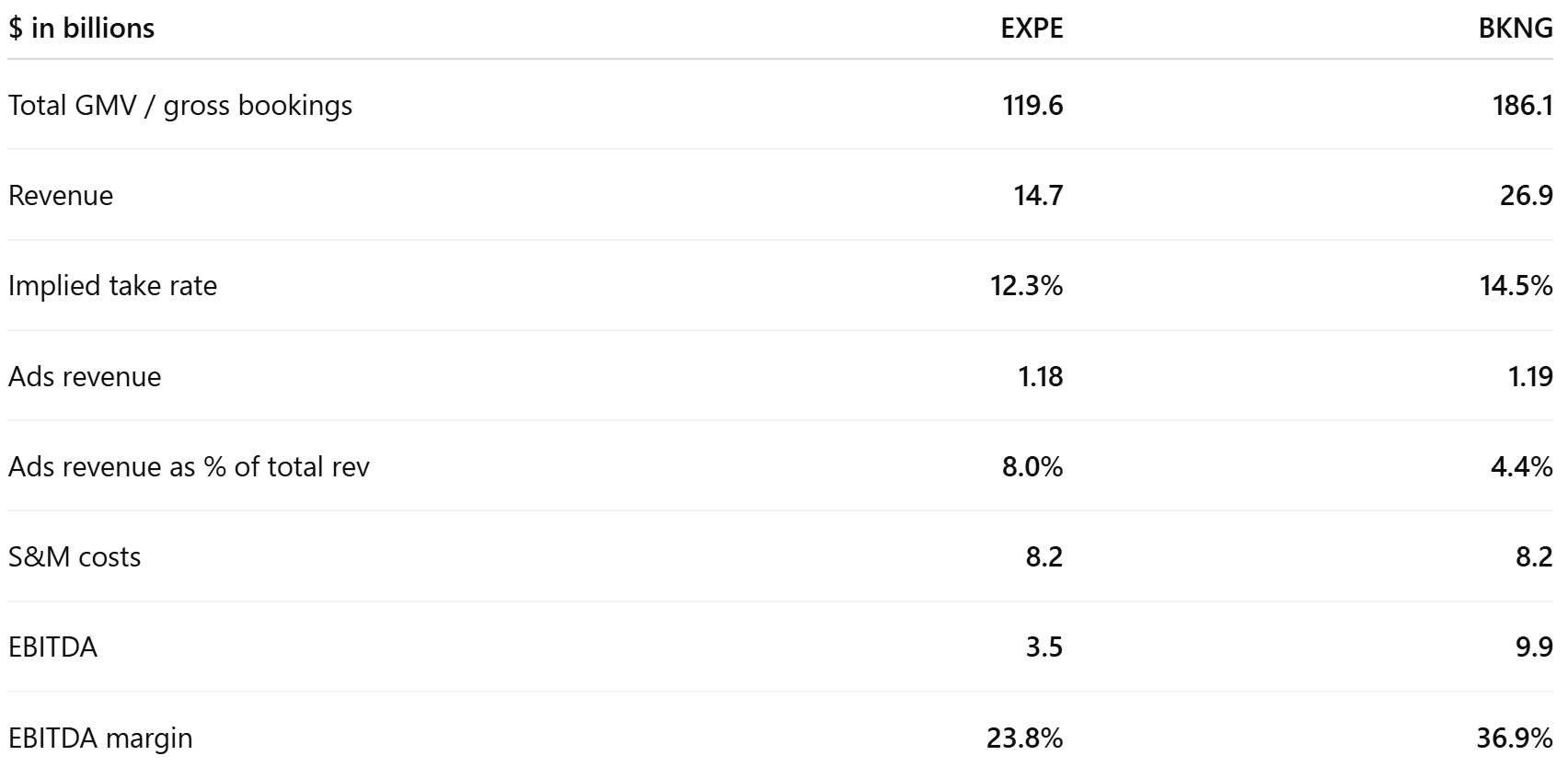
GOOGL historically makes more (~$20B of S&M) from the OTAs than OTAs’ own profits:
PYPL
Consensus arguments on the Bull case
In an agentic commerce world, trusted payment infrastructure may become even more important.
Consensus arguments on the Bear case
If dominant agents or operating systems push their own native wallet rails, PYPL could become just another payment option.
Agentic commerce may also reduce the importance of the PayPal button, since users may no longer manually choose checkout methods.
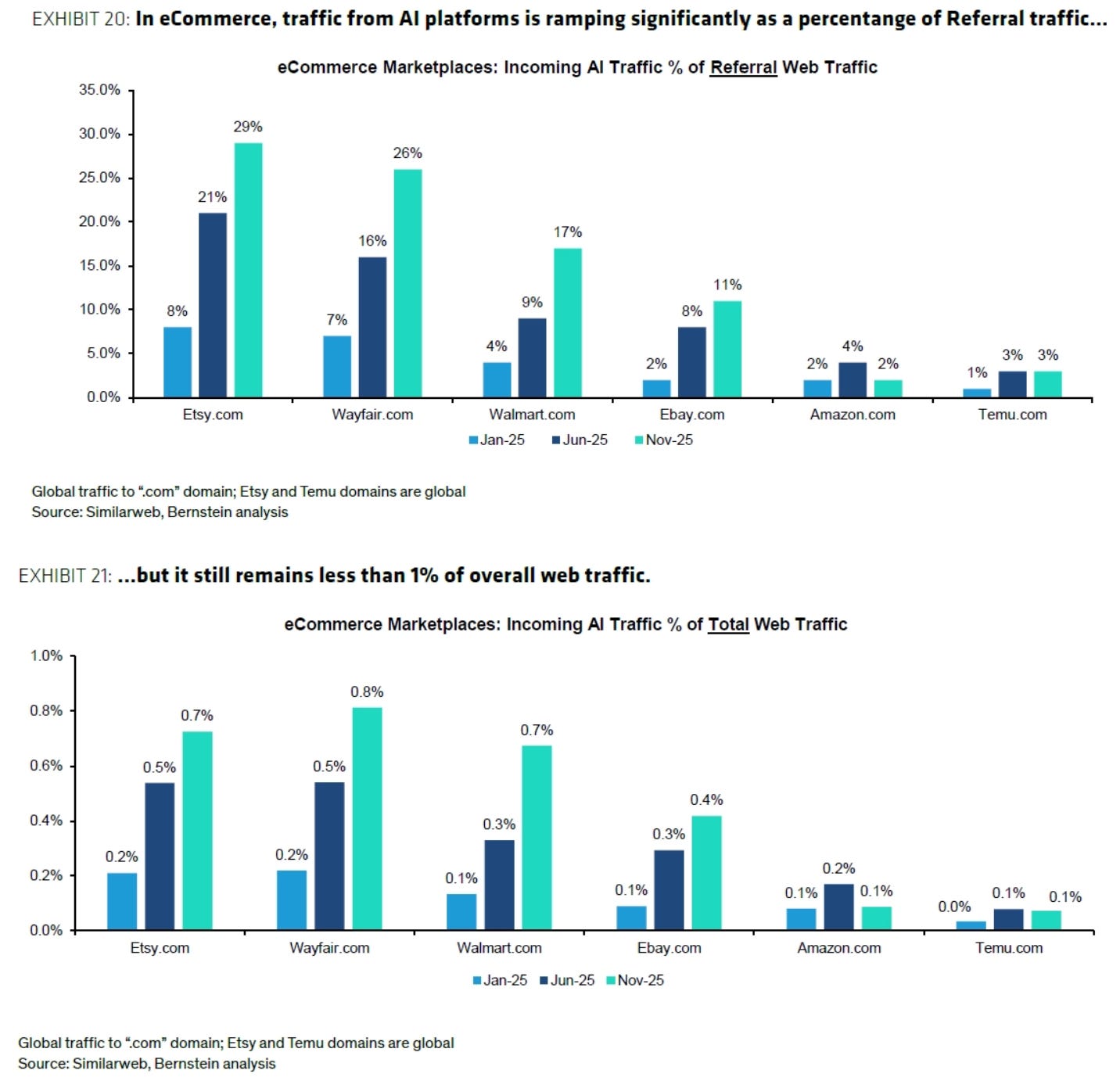
Bernstein analysis:
Source: Company financials; Visible Alpha for consensus numbers; The Information; Bernstein research reports
"The information presented in this newsletter is the opinion of the author and does not necessarily reflect the view of any other person or entity, including Altimeter Capital Management, LP (”Altimeter”). The information provided is believed to be from reliable sources but no liability is accepted for any inaccuracies. This is for information purposes and should not be construed as an investment recommendation. Past performance is no guarantee of future performance. Altimeter is an investment adviser registered with the U.S. Securities and Exchange Commission. Registration does not imply a certain level of skill or training. Altimeter and its clients trade in public securities and have made and/or may make investments in or investment decisions relating to the companies referenced herein. The views expressed herein are those of the author and not of Altimeter or its clients, which reserve the right to make investment decisions or engage in trading activity that would be (or could be construed as) consistent and/or inconsistent with the views expressed herein.
This post and the information presented are intended for informational purposes only. The views expressed herein are the author’s alone and do not constitute an offer to sell, or a recommendation to purchase, or a solicitation of an offer to buy, any security, nor a recommendation for any investment product or service. While certain information contained herein has been obtained from sources believed to be reliable, neither the author nor any of his employers or their affiliates have independently verified this information, and its accuracy and completeness cannot be guaranteed. Accordingly, no representation or warranty, express or implied, is made as to, and no reliance should be placed on, the fairness, accuracy, timeliness or completeness of this information. The author and all employers and their affiliated persons assume no liability for this information and no obligation to update the information or analysis contained herein in the future."
great write up