

There are obviously a lot of moving assumptions: how long agents stay active, how aggressively CPUs and memory can be oversubscribed, how many model calls an agent generates, and how efficiently those models are served.
Rough conclusion is:
~1–2 GW of average total power to serve 100M DAU in the base case, of which only ~0.1 GW comes from the CPU/VM layer. Depending on the # of reasoning-equivalent model calls one Muse DAU generates per day, 3-4GW is entirely plausible.
The sandbox layer = sub $1B of CPU content and ~$2B of DRAM content, which is smaller than many expected.
Welcome all feedbacks/ pushbacks.
UPDATE @ 10/07/2026
I received a lot of thoughtful pushback on the compute estimates in the original post. The disagreements seem to fall into three buckets.
1/ My CPU scope was too narrow.
My original CPU estimate focused mainly on the agent sandbox/VM. Separately, my inference estimate modeled GPUs, but did not include the head-node CPUs that support the GPU fleet.
One clarification: tool execution is not necessarily a separate CPU bucket. Browsers, code, and tools often run inside the sandbox itself; orchestration may run in a separate backend or share other CPU infrastructure.
So I now think about CPU demand as two main pieces:
Standalone / agent-execution CPU
Sandbox + the actual work happening inside it + some orchestrationHead-node CPU
CPU required alongside the GPU/XPU fleet ≈GPU/XPU fleet × CPU attach rate
2/ The sandbox itself may need more CPU than I assumed.
The original estimate used the 2 vCPU environment exposed by Muse as a starting point. But provisioning a lightweight VM is different from the physical CPU consumed once agents are actively running browsers, code, tools, and multiple tasks.
The bigger long-term question is also whether one human request continues to map to one agent. A request could increasingly spawn 4–8 sub-agents, or eventually become agent → agent → agent. Usage will likely be highly skewed toward power users, and infrastructure also needs to be provisioned for peaks rather than averages.
A more complete framework is:
Standalone CPU demand
users
×tasks/user/day
×agents/task
×active time/agent
×physical CPU per active agent
×peak factor
There are a lot of moving pieces here, but I suspect agents per task is one of the biggest long-term swing factors.
3/ Inference may also be understated, but for a different reason.
The relevant unit probably isn’t simply “human messages per day.”
A consumer might only initiate 5–10 meaningful tasks per day, but one agent task could require dozens of model calls as the agent reasons, uses a tool, observes the result, reasons again, etc. So a better framework is:
GPU inference demand
users
×tasks/user/day
×agents/task
×model steps/agent
×tokens/step
This is also where the feedback was most dispersed. Some people think 50+ model steps for a meaningful agent task is completely reasonable; others think an assumption of 50 consumer-initiated events per day is far too high. Those aren’t necessarily contradictory — tasks/day and model steps/task are different assumptions.
Where the feedback roughly landed
Among people who gave me a number, most clustered around ~0.2–0.3GW for standalone/agent CPU at 100M DAU, versus ~0.1GW in my original estimate.
Inference demand is all over the place.
And obviously, 100M DAU was just an illustrative scaling point, not a forecast of the eventual agent population. (Ref: GhatGPT has ~50M users in the US alone?)
How this compares with sell-side CPU math
The sell-side approach is generally much more top-down.
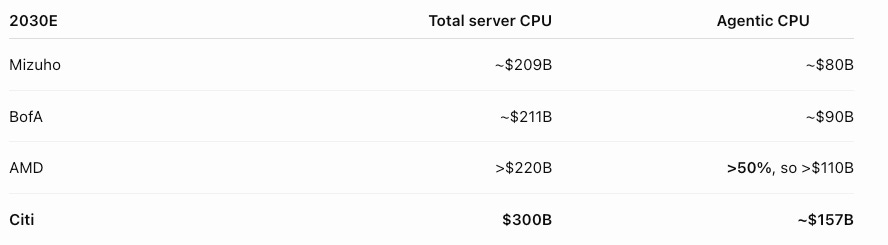
Using BofA as one example - they estimate total data-center systems TAM growing from roughly $506B in 2025 to $2.56T in 2030, while assuming CPUs remain around 7–8% of total system value. That gets them to roughly $211B of server CPU TAM in 2030.

Their CPU bull case is essentially:
AI infrastructure spending gets much larger
× AI becomes more CPU-intensive relative to GPUs
× agents create a new standalone CPU compute layer
× AI CPUs get more expensive / higher-spec
BofA splits the 2030 number into roughly $90B of GPU-attached/head-node CPUs, $90B of standalone agentic CPUs, and ~$30B of traditional server CPUs.
ORIGINAL POST @ 09/26/2026
Two very different pieces of infrastructure behind Muse.
1. Muse VM / sandbox infrastructure
2 vCPUs, ~8 GB of RAM and ~100 GB of persistent logical storage per user. Observed Muse VM configuration
2. Muse Spark inference
Model inference goes out through Meta's external inference infrastructure. Meta’s description of Muse architecture
1/ Sandbox infrastructure
A. CPU
The first mistake is assuming that 100M DAU means 100M VMs are actively consuming compute at the same time.
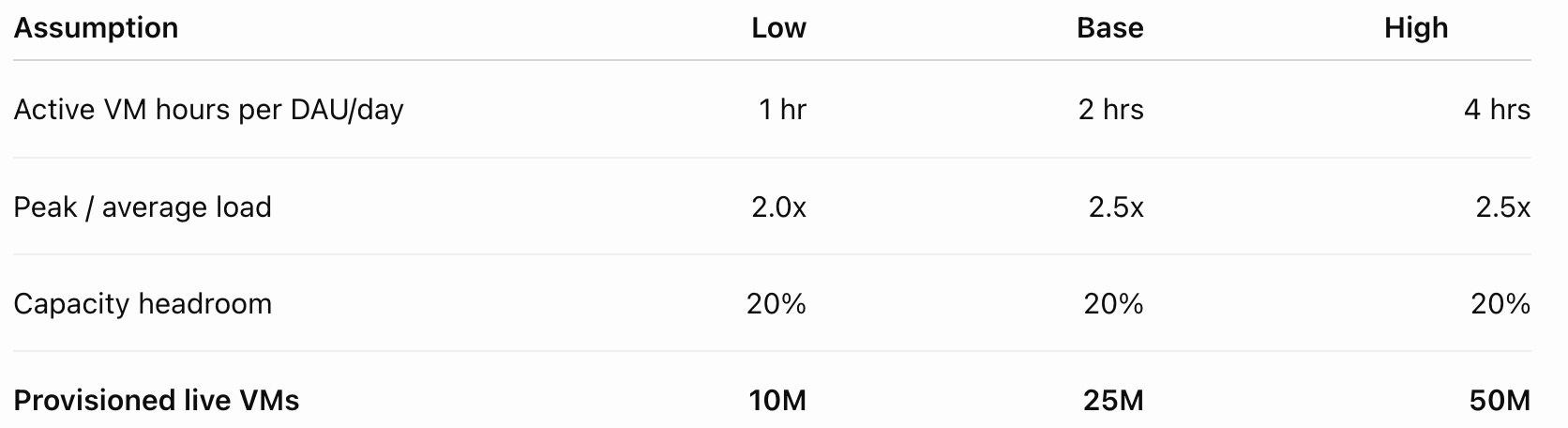
Suppose the average Muse DAU has an agent actively working for two hours per day.
100M users * 2 hours / 24 hours = ~8M average simultaneous active VMs
Meta obviously cannot provision only for the daily average. Usage will be concentrated during waking hours and bursty.
Assume a 2.5x peak-to-average ratio:
8M * 2.5 = ~20M peak active VMs
Then add roughly 20% capacity headroom: ~25M provisioned live VMs. So the base assumption is effectively that Meta needs enough infrastructure to support roughly 25% of DAU being live simultaneously.
The next important distinction is between virtual CPU allocation and physical CPU demand. Agent sandboxes are particularly well suited to CPU oversubscription. They spend a lot of time waiting. During those periods, the VM may still be alive, but it is barely using CPU.
DeepSeek’s recently published DSec infrastructure provides a useful benchmark. Its production agent sandbox platform runs approximately 30,000 physical CPU cores and 250TB of DRAM across ~160 nodes, with peak concurrency above 380,000 sandboxes. DeepSeek DSec paper. DSec also demonstrates stable operation at around: 800 microVMs per node. With roughly 188 physical cores per node: 188 physical cores / 800 microVMs = ~0.23 physical cores per live VM.
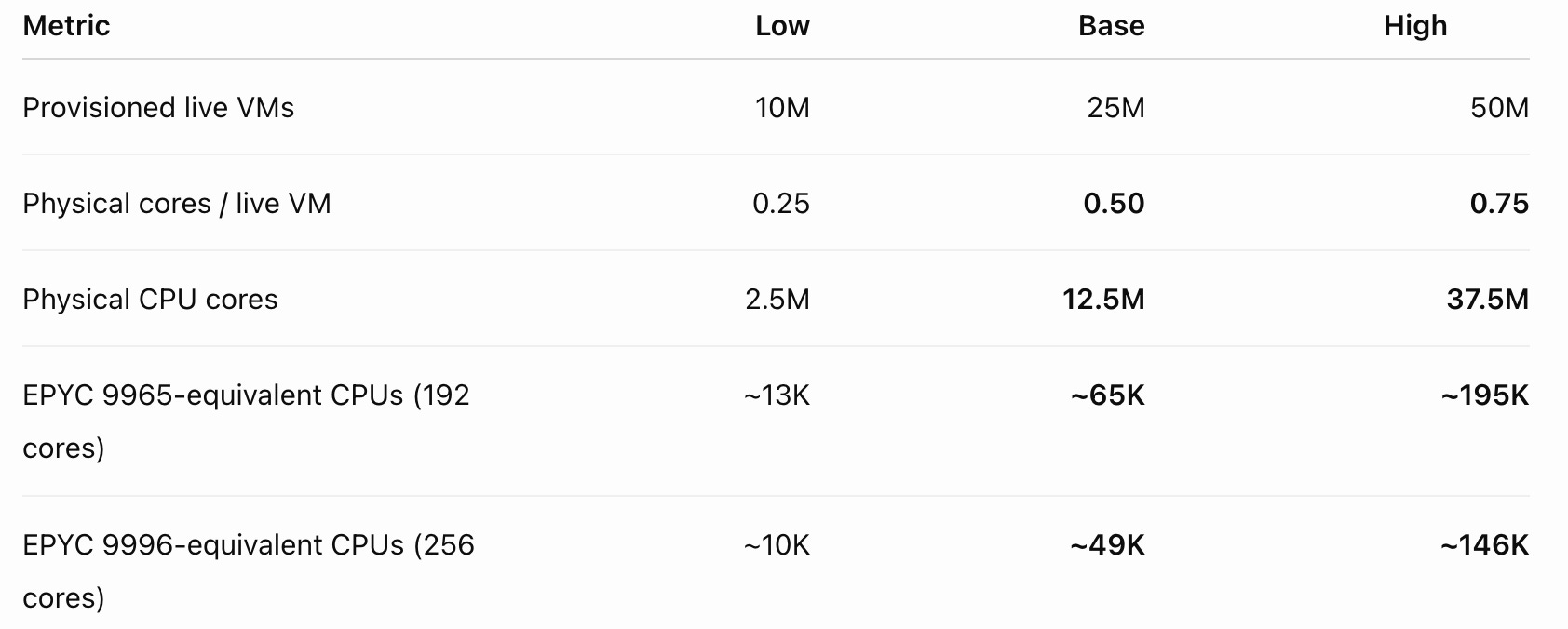
DeepSeek is obviously the King of efficiency. The number for Muse might be at 0.3-0.75 physical cores per live VM, or assume 0.5 physical cores per live VM as the base case. That is equivalent to roughly two simultaneously live Muse VMs per physical CPU core.
Using the base assumptions: 25M live VMs * 0.5 physical cores per VM = 12.5M physical CPU cores.
On a 256-core CPU: 12.5M cores / 256 cores per CPU = ~50K CPUs; Or on a 192-core CPU that would be 65K CPUs.
At the current public pricing, that is ~$800M.
B. DRAM
CPU can be aggressively oversubscribed because a VM that is waiting may consume almost no CPU. Memory is harder to oversubscribe because a live VM still needs to retain its working state.
Muse exposes roughly 8GB of RAM to the user environment, but one observed instance was actually using only around 3GB at the time of measurement.
25M live VMs * 3GB = 75PB of physical DRAM, call it ~75-100PB of physical DRAM feels like a reasonable base range.
At the current public pricing, that is ~$2B.
C. Sandbox power
~0.1 GW for the entire Muse sandbox / VM layer at 100M DAU.
2/ Inference
Muse’s personal computer executes tools and stores state locally, but the actual model runs on separate inference infrastructure. Meta’s Muse architecture
Energy per inference event
Microsoft’s 2026 study estimates that optimized frontier-scale inference consumes a median of approximately: 0.31Wh per normal query
But a long reasoning query with roughly 15x the token count consumes approximately 13x as much energy, or around: 4Wh per long reasoning query
The study specifically highlights reasoning and agentic workloads as significantly more energy intensive. Microsoft Research on AI inference energy
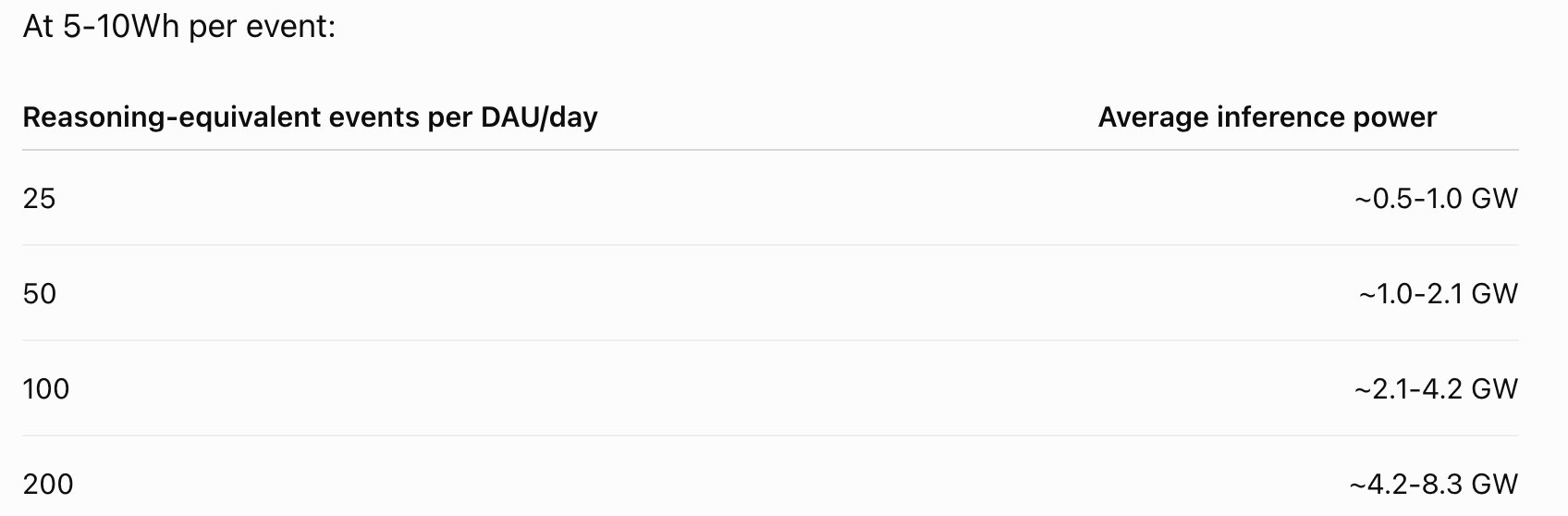
For a Muse-like workload, let’s assume 5-10Wh per heavy reasoning-equivalent inference event as a rough sensitivity range.
Sensitivity analysis on # reasoning-equivalent events per DAU per day
Assume 50 reasoning-equivalent events per DAU per day
Suppose each active Muse user generates the equivalent of 50 heavy inference events per day.
At 5Wh each:
100M users * 50 events/day * 5Wh = 25GWh/day
25GWh/day / 24 hours = ~1.0GW average power
So inference alone could require: ~1-2GW of average power
So a 3-4GW Muse is entirely plausible. Maybe that’s why Meta is rumored to be adding 7-10GW of compute next year.
Bottom line
The popular framing around Muse is that giving every user 2 vCPUs and 8GB of RAM creates an enormous CPU requirement. But the naive calculation materially exaggerates the CPU requirement because it treats logical VM allocation as dedicated physical infrastructure.
The more interesting conclusion is: Consumer agents may be a meaningful new demand driver for CPUs and conventional DRAM, but inference remains the real compute bottleneck. And as agents do more work, run longer trajectories and increasingly spawn other agents, inference demand can scale much faster than the number of users itself.
My CPU estimate is quite close to yours. I used physical core-minutes: DAU × daily agent runtime × average physical cores actually consumed, then adjusted for peak demand and capacity headroom.
For 100M DAU, my base case assumes 60 minutes per user per day at one physical core on average. With a 2× peak-to-average ratio and 60% target utilization at peak, that implies ~13.9M physical cores, versus your ~12.5M. On a 128-core basis, that’s roughly 109K CPUs versus 98K.
So I agree that the CPU requirement looks more modest than the “dedicated computer for every user” framing suggests. The key is actual core consumption over time, rather than the vCPUs allocated to each VM.
<1B CPU, 2B DRAM, 1GW AIDC means 25-30B content of GPU?
It seems NVIDIA is the biggest winner of 2C Agent