
$10 Trillion Robots
Why AI, data, and hardware are aligning to bring general-purpose robots out of the lab and into the real world

AI in robotics is set to drive the next major platform shift. Every step forward is worth celebrating—because “human in a suit” is no longer sci-fi. It’s coming.
On Tesla’s latest earnings call, Elon dropped another big number:
“Optimus has the potential to be north of $10 trillion in revenue.”
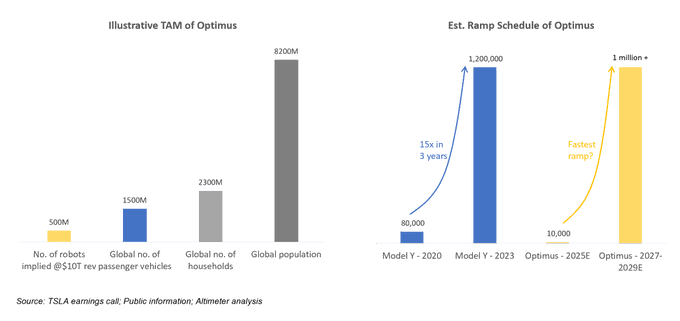
At a $20,000 average selling price (ASP), that implies 500 million robots—roughly 5% of today’s global population. Sounds insane, right?
But put that next to the 1.5 billion passenger cars already on Earth—suddenly, it doesn’t sound so far-fetched.
🤖 Why Robot Ownership Could Eclipse Cars
Let’s break it down:
1. Use Cases Go Far Beyond Transportation
Cars get you from point A to B. That’s it.
Humanoid robots could work in homes, warehouses, retail, eldercare, hospitality, food prep, security—virtually anywhere human labor is used.
2. Cost Will Be Lower Than Cars
Elon expects Optimus to cost about half as much as a car. That makes mass adoption more accessible. Imagine a $20K robot that can do household chores, lift heavy boxes, or assist an aging family member 24/7.
🔁 A Future of One Robot per Human?
Elon’s long-term vision: a 1:1 human-to-robot ratio, or ~10 billion humanoid robots.
Sounds ambitious—but when you zoom out, it’s not irrational:
Global labor market = billions of roles, many repetitive
Demographic aging = exploding need for care and assistance
Robots don’t sleep, call in sick, or retire
🚀 How Fast Could Tesla Scale Optimus?
Elon also noted:
“Our goal is to run Optimus production faster than maybe anything has ever been ramped.”
Let’s use the Model Y as a reference:
2020: ~80K units
2021: ~410K units → 5x in Year 1
2023: ~1.2M units → 15x in 3 years
If Tesla applies this same ramp logic to Optimus, a 5–10x production increase per year in the first 1–2 years is not out of the question.
🔧 Robotics: The Ultimate Challenge
The potential is enormous. Goldman Sachs projects $150B+ in robotics revenue over time. With over 50% of global GDP tied to labor, 2B+ families, and 700M elderly in need of care, robotics isn't optional—it’s inevitable.
But it’s also one of the hardest problems in tech:
A perfect storm of hardware, software, and AI.
We’ve made progress in single-purpose robots (e.g., warehouse automation, surgical bots), but general-purpose robotics is still out of reach for the mass market.
To build robots that truly understand and interact with the world like humans do, we need breakthroughs on two fronts:
1/ Data Is Scarce and Expensive
We’ve trained LLMs on 15 trillion text tokens.
Robotics? We’re still at the toddler stage.
While advances in teleoperation, AR, video learning, and simulation help, real-world data remains scarce—and essential. Google reportedly spends $300/hour collecting it.
And unlike language, physical data is expensive, hard to scale, and often non-transferable across form factors.
2/ Hardware Is Delicate and Complex
Dexterous, human-like hands remain a massive challenge.
Replicating the flexibility, control, and strength of human limbs is no small feat.
Physical interaction requires low-latency, real-time control with millimeter precision—and zero margin for error.
This is where global collaboration should shine:
🇨🇳 China excels in hardware but lags in foundational AI.
🇺🇸 U.S. leads in AI but struggles with hardware scale.
Yet geopolitics now forces U.S. companies to own their entire stack—design, train, and manufacture in-house—making the road longer and more expensive.
Cost Will Drop, Adoption Will Follow
Today, a high-end humanoid can cost $300K+.
That’s not viable for mass adoption.
But as with all technologies, cost curves bend. I’m confident we’ll see prices drop below $30K—opening the door for real-world deployment at scale.
🧠 AI + Robotics = Real-World Foundation Models
Robotics needs its own foundation models—but for the physical world. That means models that:
Understand affordances and object relationships
Reason about motion and cause-effect
Adapt to diverse, unpredictable environments
The field is now shifting from rule-based control → end-to-end learning, just like self-driving did.
But while driving involves a few outputs (steer, brake, accelerate), robots deal with dozens of degrees of freedom—making the control space exponentially harder.
🤖 Form Factor Fatigue
The lack of a standardized form factor is slowing progress:
Humanoids, quadrupeds, wheeled bases, arms-on-tracks…
Each one requires its own training data, controls, and hardware optimization
Until the industry converges on a dominant form, data remains fragmented—and progress bottlenecked.
🚗 Robotics Feels Like Self-Driving in 2020
Self-driving hit its “iPhone moment” in 2024 with FSD v12—a move from heuristics to AI-native systems.
Robotics is on a similar path.
We’re leaving behind scripted behaviors.
We’re building AI systems that learn by doing.
And we’re getting close to breaking through.
It’s Not If. It’s When.
Robotics will reshape labor, healthcare, logistics, aging, and how we interact with the physical world.
It’s no longer a question of possibility.
It’s a matter of timing—and the signs are all pointing to soon.